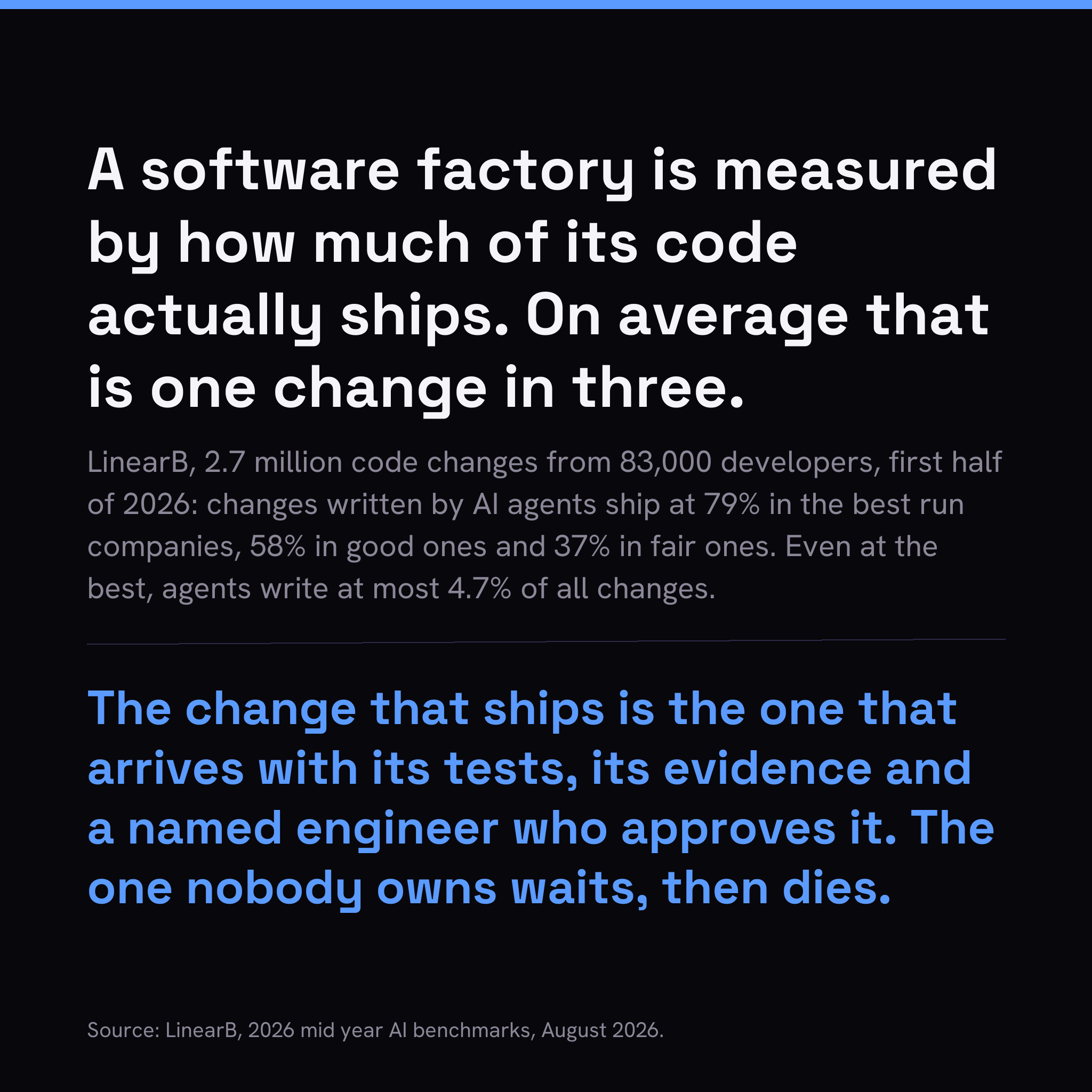
A software factory, a pipeline that takes specifications in and produces code out, is measured by one thing: what merges, that is, what ships. LinearB measured it, and on average the answer is one pull request in three.
LinearB's 2026 mid year benchmarks, published August 4, 2026 on 2.7 million pull requests (code changes) from 83,000 developers, put it in tiers. Pull requests overall merge within 30 days 90% of the time at elite organizations, 86% at good ones, 81% at fair ones. Pull requests opened by agents merge at 79%, 58% and 37%. In the full year sample of 8.1 million, AI generated pull requests were accepted at 32.7% against 84.4% for human written ones, and waited 4.6 times longer before anyone looked.
Even at the elite tier, agents author at most 4.7% of pull requests. The factory, measured, is one pull request in twenty.
Mike Julian (@mikejulian), CEO of The Duckbill Group, wrote on X on September 6, 2026 that his team of five found itself with 60 open pull requests and two days of review ahead, and mostly ditched code review.
On our own line, which builds and maintains a SaaS product of our own, the pull request that merges is the one that leaves the factory with its tests, its evidence and a named engineer who approves it. The one nobody owns waits, then dies.
Sources
- LinearB, Your software factory needs a context layer (2026 mid year AI benchmarks), August 4, 2026. https://linearb.io/blog/does-your-software-factory-work
- LinearB, 2026 Software Engineering Benchmarks Report, public summary page. https://linearb.io/resources/software-engineering-benchmarks-report
- Mike Julian on X, September 6, 2026. https://x.com/mikejulian/status/2096665515708301424