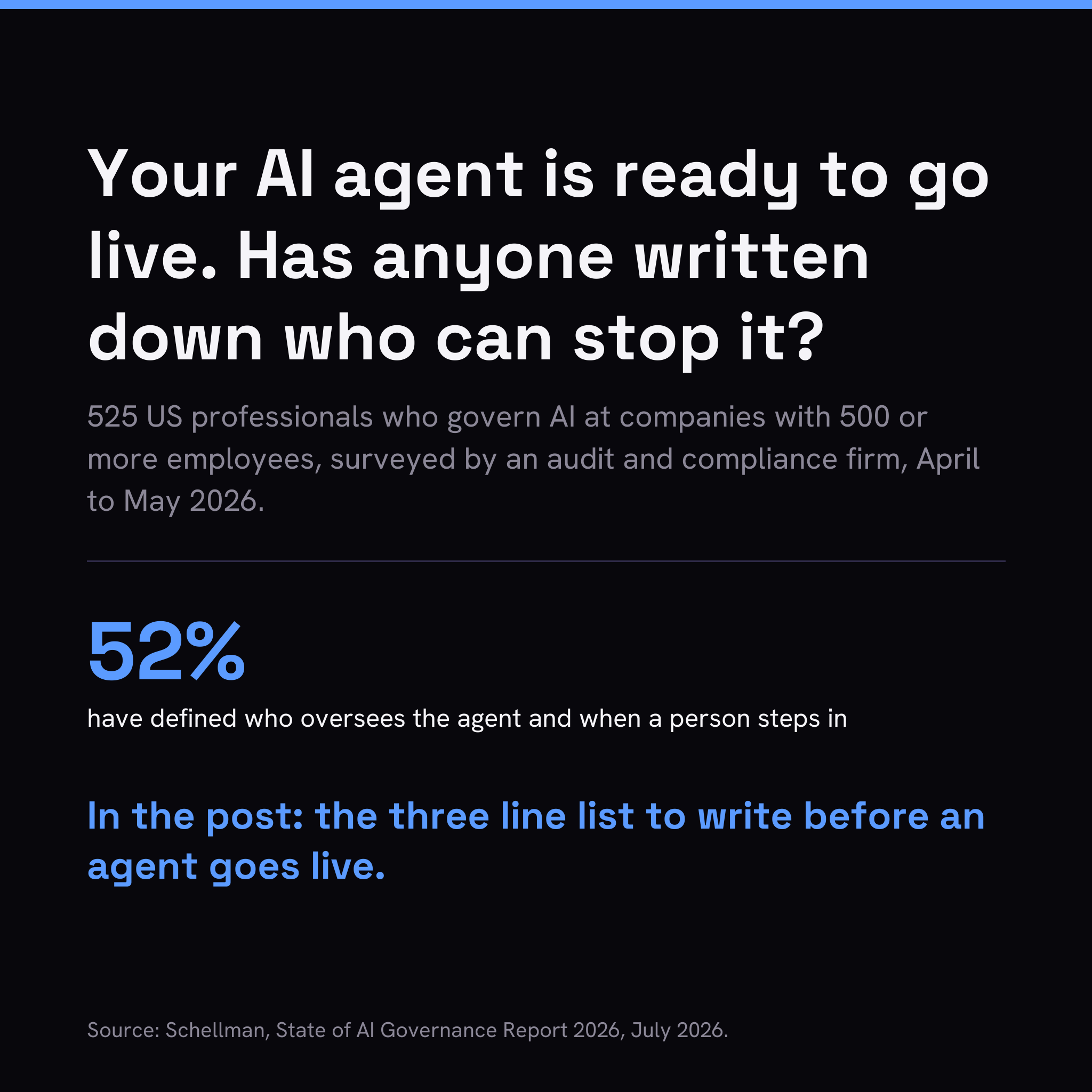
The first question we write for any agent an IT department puts into operation is who can stop it and when. A survey says half of large companies skipped it.
Schellman, an audit and compliance firm, surveyed 525 US professionals who govern AI at companies with 500 or more employees between April 13 and May 11, 2026, and published the results on July 29, 2026; the results are not weighted. 86% say they have tested or piloted AI agents and 46% have them in production: 78% among companies with mature governance, against 22% among those still developing it. The survey shows the two go together; it does not say which came first. Schellman's note of September 9, 2026 adds that only 52% of organizations with agents in testing or production have defined human oversight and escalation requirements.
BCG, the consulting firm, quoting its chief AI ethics officer Steve Mills, on X: many governance programs were designed for two or three centrally managed pilots, not for the scale of agentic AI deployment today.
In one IT department the list took an afternoon: what the agent does alone (reads, drafts, routes), what it proposes (any change to a record), who gets paged when it is unsure, and how to undo an action. The agent went live the next week. Before the list it had waited four months.
The escalation path is not the brake on the agent. It is what lets you turn it on.
Sources
- Schellman, State of AI Governance Report 2026, press release of July 29, 2026 (GlobeNewswire).
- Schellman, Closing the AI governance readiness gap, September 9, 2026. https://www.schellman.com/blog/ai-governance/closing-the-ai-governance-readiness-gap
- BCG on X, September 14, 2026. https://x.com/BCG/status/2099422903359979945