In one SaaS team the month after the coding agent arrived was its best ever by lines merged. The quarter after was the worst by bugs. A study describes the curve.
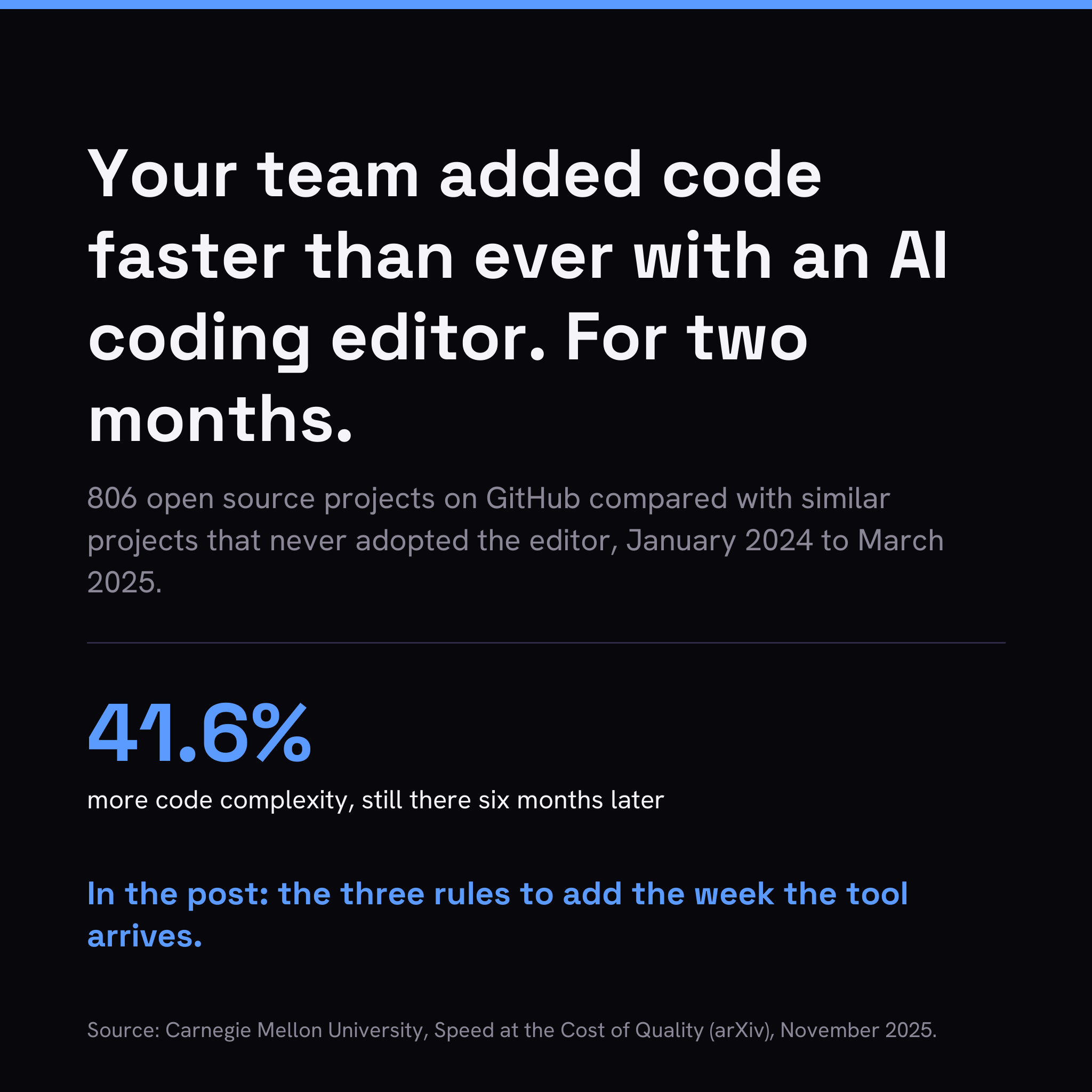
Hao He and four colleagues at Carnegie Mellon University published on November 6, 2025, revised on January 26, 2026, a study of 806 open source projects on GitHub, not company teams, that adopted one widely used AI coding editor between January 2024 and March 2025, compared with similar projects that never did. Lines added rose 28.6% on average, all of it in two months: 281.3% in the first, 48.4% in the second, nothing significant after. Static analysis warnings rose 30.3% and code complexity 41.6%, and both stayed up for the six months measured. In their model, doubling complexity cuts later lines added by 64.5%.
Mitchell Hashimoto, cofounder of HashiCorp, on X: his benchmark for responsible AI use is the whiteboard defense, being able to explain any customer facing system you shipped and defend the decisions in it.
What fixed that team was not slowing the agent down. It was a complexity budget per change, and one engineer who owned the modules the agent liked to grow. Output settled below month one and above month zero.
Speed you cannot explain at a whiteboard is debt. The study measured when it comes due.
Sources
- Hao He, Courtney Miller, Shyam Agarwal, Christian Kästner and Bogdan Vasilescu (Carnegie Mellon University), Speed at the Cost of Quality: How Cursor AI Increases Short-Term Velocity and Long-Term Complexity, arXiv 2511.04427, November 6, 2025, revised January 26, 2026. https://arxiv.org/abs/2511.04427
- Mitchell Hashimoto on X, September 16, 2026. https://x.com/mitchellh/status/2100249348345057389