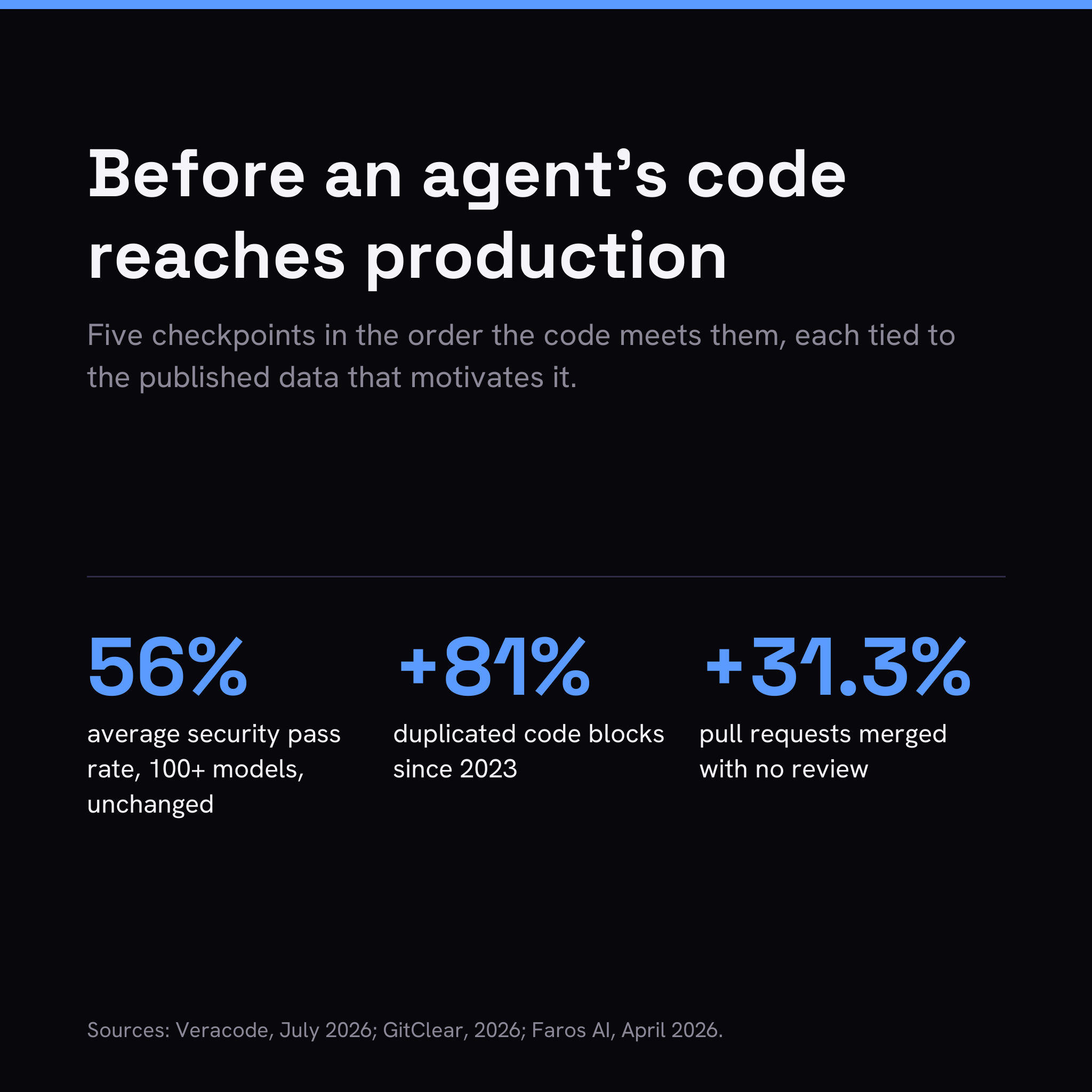
This document describes the five gates that code written by an agent passes before it reaches production, in the order the code meets them, with the check to run at each and the published finding behind it. It ends with a five day plan to put the gates in place and how we run them on our own work.
1. What the published data says about generated code
Three sources, three different lenses, one direction.
Security. Veracode's 2026 GenAI Code Security Report tested 11 new models across 80 tasks and reports that across more than 100 models tested over four years, the average security pass rate sits at 56% and has not moved. The best model in the summer 2026 dataset passes 68% of security tasks; six of eleven sit between 50% and 53%. Java is the weakest language at a 30% mean pass rate. Models built for code average 51%; general purpose models, 52%. Being trained to write code faster does not mean writing it safer.
Maintainability. GitClear analyzed 623 million code changes from 2023 to 2026. Duplicated code blocks (five or more consecutive repeated lines) rose 81% since 2023 to the highest level on record. Moved code, the signature of refactoring, fell from 21% of changed lines in 2022 to 3.8% in 2026, while copy and paste climbed from 9.4% to 15.7%. New code connects to existing functions 35% less often. The share of changes that touch code older than a year fell 74%. Error masking constructs are up 47% and two week churn up 15%.
Flow. Faros AI's 2026 telemetry across 22,000 developers found pull requests merged with no review at all up 31.3% under high AI adoption, and incidents per merged pull request up 242.7%.
The checklist exists because every one of these is a measurable property of a change, and every one can be checked before a human sees it.
2. The principle: sensors before eyes
The harness engineering framework (Böckeler, martinfowler.com, April 2, 2026) gives the vocabulary. An outer harness around a coding agent has two kinds of controls. Guides act before the agent writes: conventions, constraints, instructions for a task. Sensors act after: tests, linters, structural checks, review instructions. Guides raise the chance the agent gets it right the first time; sensors let it correct itself before a person is involved.
Each control is either computational (deterministic, fast, run by the CPU: tests, type checks, linters, architecture tests) or inferential (a model judging code: semantic duplication, over engineering, a review against a rubric). Computational sensors are cheap enough to run on every change. Inferential ones are slower and probabilistic, and they catch what the deterministic ones cannot.
The framework's timing rule is the one that organizes the gates: keep quality left. Run what is fast before integration, run what is expensive after, and run drift sensors continuously against the codebase outside the change lifecycle. The human's job is the steering loop: every time an issue repeats, the harness gains a guide or a sensor so it repeats less.
3. The five gates
Gate 1. Before the agent writes.
- A written task with acceptance criteria the agent can test against. Source: harness engineering (guides).
- A conventions file in the repository: architecture, module boundaries, what is deprecated, how to run tests. Source: harness engineering; DORA's finding that an agent replicating deprecated patterns amplifies debt.
- Security constraints stated in the task, not assumed: input handling, secrets, authentication boundaries, the language's known weak spots. Source: Veracode (56% average pass rate; Java at 30%).
- A size expectation for the change. Source: Faros (PR size up 51% under high adoption).
Gate 2. While the agent works.
- Unit and integration tests run by the agent itself before it reports done. Source: harness engineering (computational sensors on every change).
- Type checks and linters with messages written for the agent, so the fix is in the error. Source: harness engineering ("a positive kind of prompt injection").
- A structural test that fails on module boundary violations. Source: harness engineering (architecture fitness harness).
- A duplicate block tripwire: the change fails if it adds a block of five or more lines that already exists. Source: GitClear (duplication up 81%; recommendation "put a tripwire on duplicate blocks").
- An error masking check: broad exception catches, swallowed errors and silenced warnings are flagged. Source: GitClear (error masking constructs up 47%; recommendation "review for error-masking explicitly").
Gate 3. Before merge.
- Static security analysis on the diff, with the result attached to the pull request. Source: Veracode.
- A dependency check on anything the agent added. Source: harness engineering (dependency scanners as drift sensors).
- An agent review against a written rubric (intent, reuse of existing functions, test quality) that runs before a human reviewer is assigned. Source: harness engineering (inferential sensors); GitClear (function connectivity down 35%).
- A hard size limit. Over the limit, the change is split. Source: Faros; DORA (small batches amplify product performance).
- Human review by exception, with the exceptions written down: security boundaries, large blast radius, unfamiliar critical code, any change the author is not confident in. Source: Laycock, martinfowler.com, September 2026.
- Zero merges without review of any kind. Source: Faros (unreviewed merges up 31.3%).
Gate 4. After merge.
- Churn on recently added lines: how much of last month's generated code was deleted or rewritten this month. Source: Faros (churn up 861%); GitClear (two week churn up 15%).
- Incidents traced to merged changes, per change, month over month. Source: Faros (incidents per merged PR up 242.7%).
- Share of changes touching code older than a year, as a signal that maintenance is still happening. Source: GitClear (long term update share down 74%).
- Continuous drift sensors: dead code, test coverage quality, dependency age. Source: harness engineering.
Gate 5. The human's job.
- Every issue that a reviewer catches twice becomes a guide (a rule the agent reads) or a sensor (a check that runs). Source: harness engineering (the steering loop).
- Refactoring and legacy maintenance get a budget, because the agent's default is to add rather than consolidate. Source: GitClear (recommendation "budget for refactoring and legacy maintenance").
- The rubric, the conventions file and the tripwires are versioned with the code, so the harness survives the person who built it.
4. Running it in a week
Day one: write the conventions file and the review rubric, both short. Day two: turn on the computational sensors that already exist in the stack (tests, types, linters) as agent facing checks, and add the duplicate block tripwire. Day three: add static security analysis to the pull request and set the size limit. Day four: write the review by exception list and remove the path that lets a change merge with no review. Day five: put the three post merge measures on a page someone looks at monthly. Gate 5 starts the first time something gets caught twice.
5. How we run it on our own work
On our own work, and inside the SaaS teams where we run it, a coding agent does not open a pull request until its own tests, the type checker, the linters and the structural test pass, and the review rubric runs before a person is assigned. The conventions file is the first thing written in a new repository and the first thing updated when a reviewer catches a repeat. The size limit is enforced by the pipeline, not by asking. Security analysis runs on the diff, and the language's weak spots are stated in the task. The post merge measures are read monthly and the harness changes when they move.
That is the method. The checklist is the version of it that fits on one page.
Sources
- Veracode, 2026 GenAI Code Security Report, July 2026. https://www.veracode.com/resources/analyst-reports/2026-genai-code-security-report/
- GitClear, The Maintainability Gap: AI Code Quality in 2026, 2026. https://www.gitclear.com/the_ai_code_quality_maintainability_gap
- Birgitta Böckeler, Harness engineering for coding agent users, martinfowler.com, April 2, 2026. https://martinfowler.com/articles/harness-engineering.html
- Faros AI, Ten takeaways from the AI Engineering Report 2026: The Acceleration Whiplash, April 12, 2026. https://www.faros.ai/blog/ai-acceleration-whiplash-takeaways
- Rachel Laycock, Maybe We Shouldn't Be Reviewing All This Code, martinfowler.com, September 2, 2026. https://martinfowler.com/rachels-ramblings/code-review.html
- DORA, Capability catalog: AI-accessible internal data; Working in small batches. https://dora.dev/capabilities/
Analysis and conclusions by yaab, based on the published reports listed above.