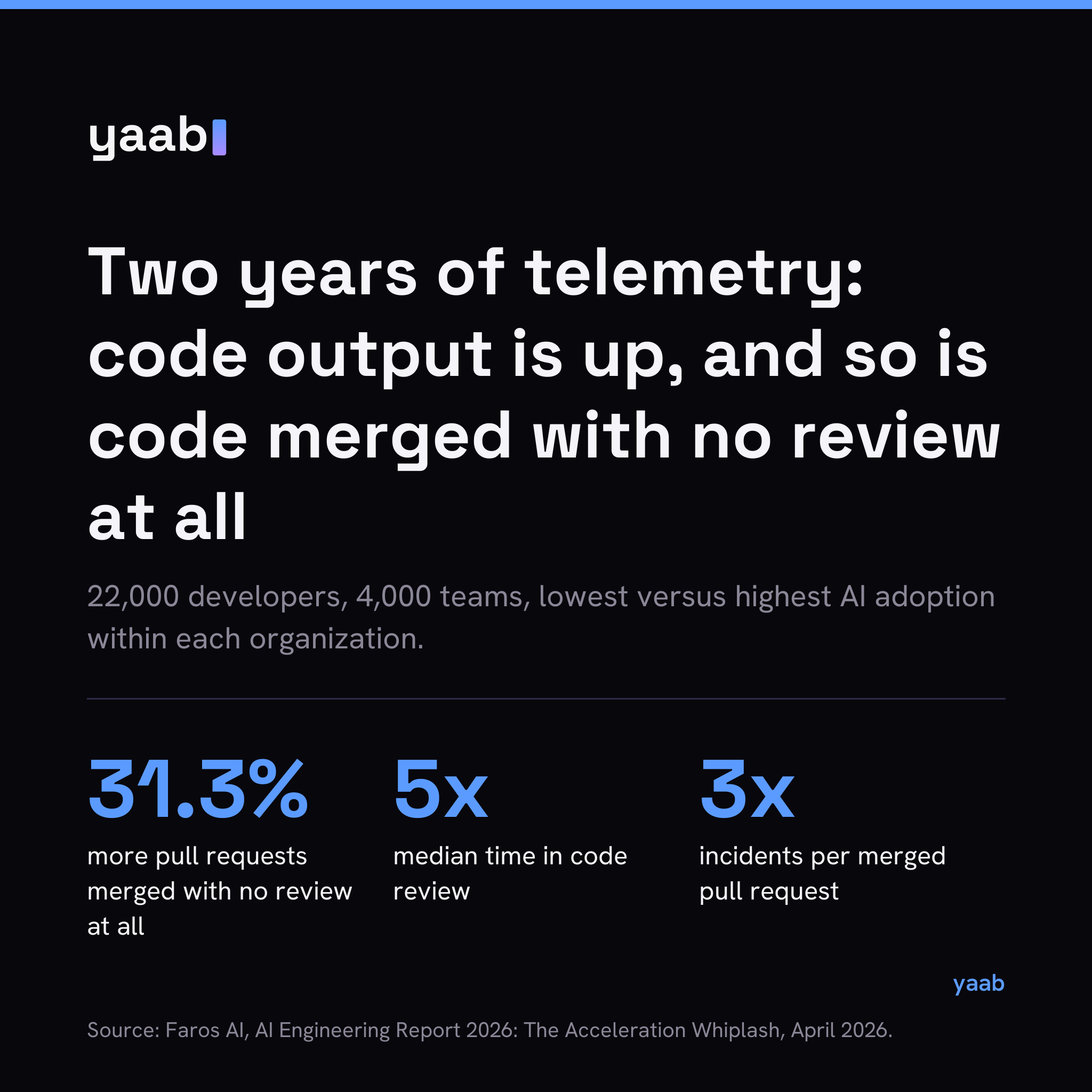
The most useful number in Faros AI's 2026 engineering report is not the throughput gain. It is the 31.3% rise in pull requests merged with no review at all.
The report draws on two years of telemetry from 22,000 developers and more than 4,000 teams (April 2026). Output rose: task throughput per developer up 33.7%, epics completed up 66%. Review did not keep up: median time in review up 441.5%. Faros calls it the senior engineer tax. When reviewers cannot keep pace, code goes through unread, and incidents per merged pull request are up 242.7%.
I have lived that queue inside a client team. What held was not reviewing faster. It was moving checks in front of the human, so that what reached a senior was the fraction that needed one.
Two people I read said the same in 2026. Addy Osmani (Google) on X: every pull request gets an agent first pass, humans cover blast radius, "don't read all the code". Charity Majors, CTO of Honeycomb, on the Pragmatic Engineer podcast: code review is "hugely overloaded", and validation was never its most important part.
My reading: review is where an AI initiative is won or lost, and it is won by deciding what a human reads.
Sources
- Faros AI, Ten takeaways from the AI Engineering Report 2026: The Acceleration Whiplash, April 2026. https://www.faros.ai/blog/ai-acceleration-whiplash-takeaways
- Addy Osmani on X. https://x.com/addyosmani/status/2097027173941141799
- Charity Majors quoted by The Pragmatic Engineer on X. https://x.com/Pragmatic_Eng/status/2089412107502604292