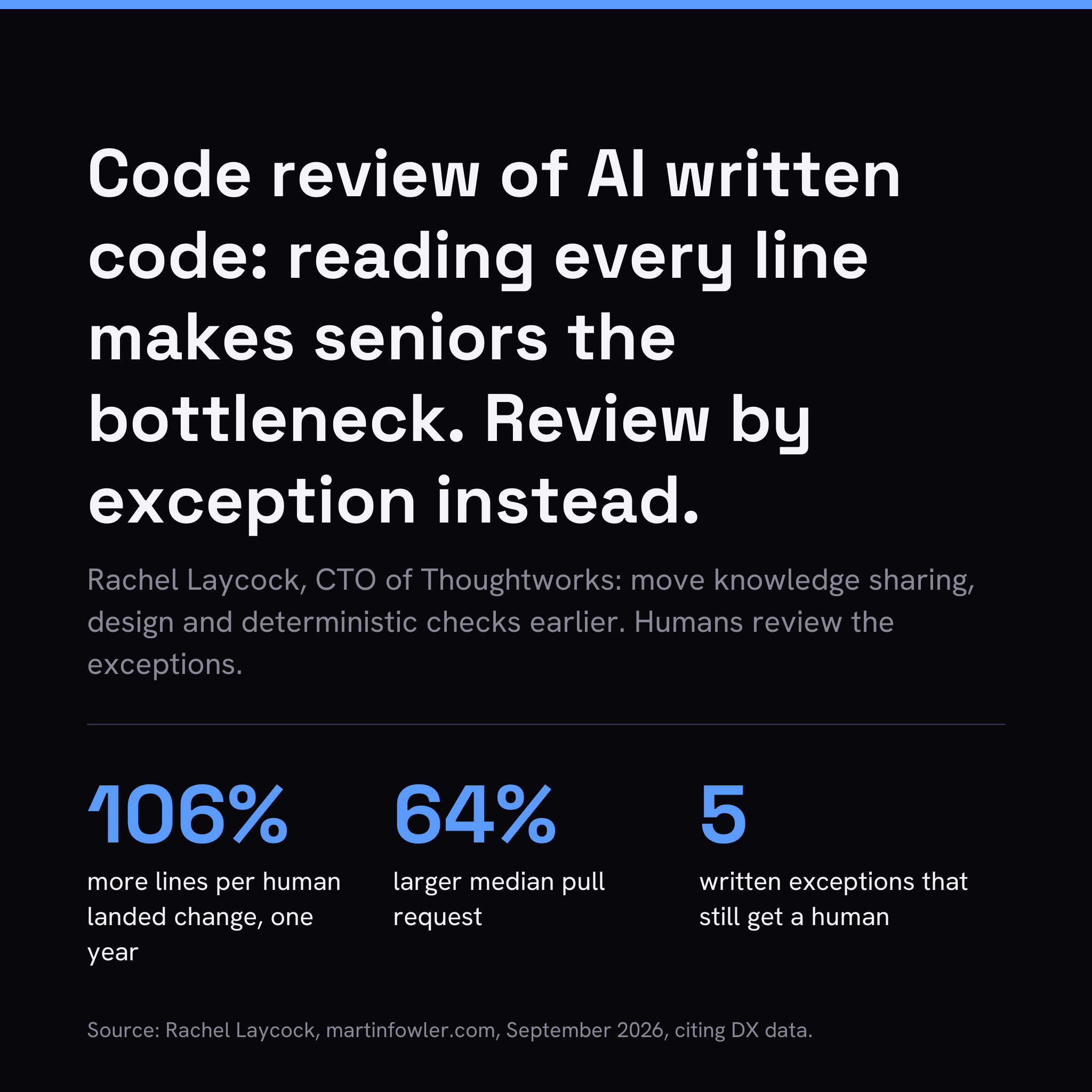
If every line an AI agent writes has to wait for a senior engineer to read it, you have not built a faster team. You have built a queue.
Rachel Laycock, CTO of Thoughtworks, made that argument on martinfowler.com on September 2, 2026, answering a colleague from DX who wants to keep human review of everything. She cites his numbers: at one large company, lines of code per human landed change up 106% in a year; across DX's data, median pull request size up 64%. Her position is that code review has been carrying too many jobs and that most of them belong earlier: pairing, design sessions, constraints encoded as tests, anything deterministic automated. Humans review by exception: an architectural change, a sensitive security boundary, a large blast radius, unfamiliar critical code, or anyone saying "I am not confident about this."
That is the rule I run inside client teams. The exceptions are written down. Everything else passes automated checks and an agent review against a rubric before a person is assigned.
Kent Beck, creator of test driven development, quoted by The Pragmatic Engineer on X: feedback comes in layers like a filter; the bad stuff sticks, the good stuff still goes through. Review is one layer. It was never meant to be the only one.
Sources
- Rachel Laycock, Maybe We Shouldn't Be Reviewing All This Code, martinfowler.com, September 2, 2026. https://martinfowler.com/rachels-ramblings/code-review.html
- Kent Beck, quoted by The Pragmatic Engineer on X, August 18, 2026. https://x.com/Pragmatic_Eng/status/2089706555104989548