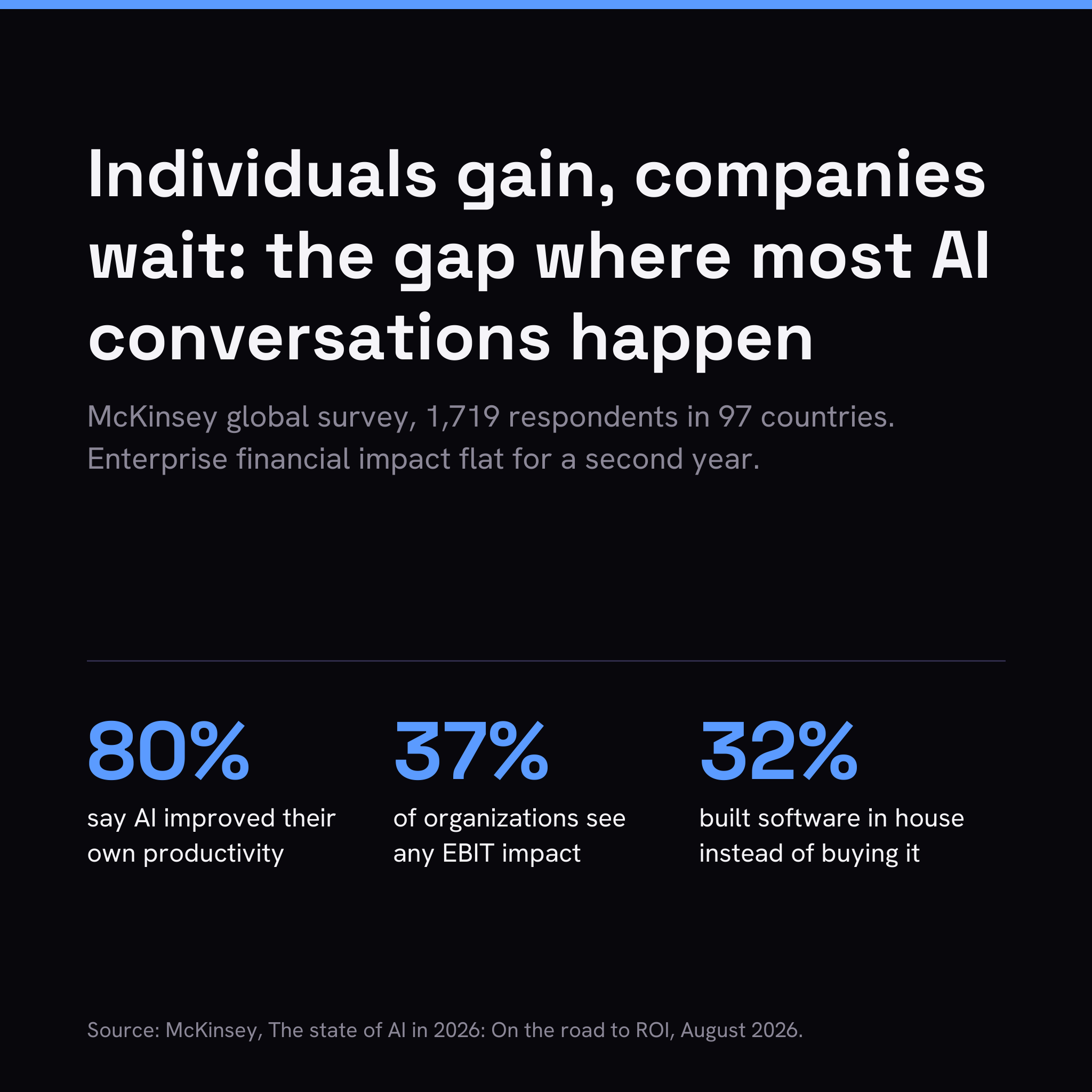
Eight in ten people say AI made them more productive. Thirty seven percent of their companies can see it in the earnings. Most of my conversations with IT leaders happen in the gap between those two numbers.
McKinsey's global survey, published August 25, 2026 (1,719 respondents, 97 countries): nearly nine in ten organizations use AI in at least one function and 44% are scaling it across the enterprise, up from 38%. Eighty percent of respondents say AI improved their own productivity. Thirty seven percent report any effect on EBIT, unchanged from last year. The 6% McKinsey calls high performers are the ones redesigning workflows rather than inserting AI into existing ones: nearly three quarters of them did, against one quarter of everyone else.
What I see in IT departments whose business is not software: the individual gains are real, the mandate from the board is real, and nobody on the team can take one problem from spec to production and then operate it. That is where the gap lives.
McKinsey said it on X: adding AI to software development is becoming the easy part; the bigger opportunity is rethinking roles and ways of working around it.
Sources
- McKinsey, The state of AI in 2026: On the road to ROI, August 2026. https://www.mckinsey.com/capabilities/quantumblack/our-insights/the-state-of-ai
- McKinsey on X. https://x.com/McKinsey/status/2094394989740445758